The Game Beyond the Game
As the games industry matures, the next durable advantage will be built around the game itself.
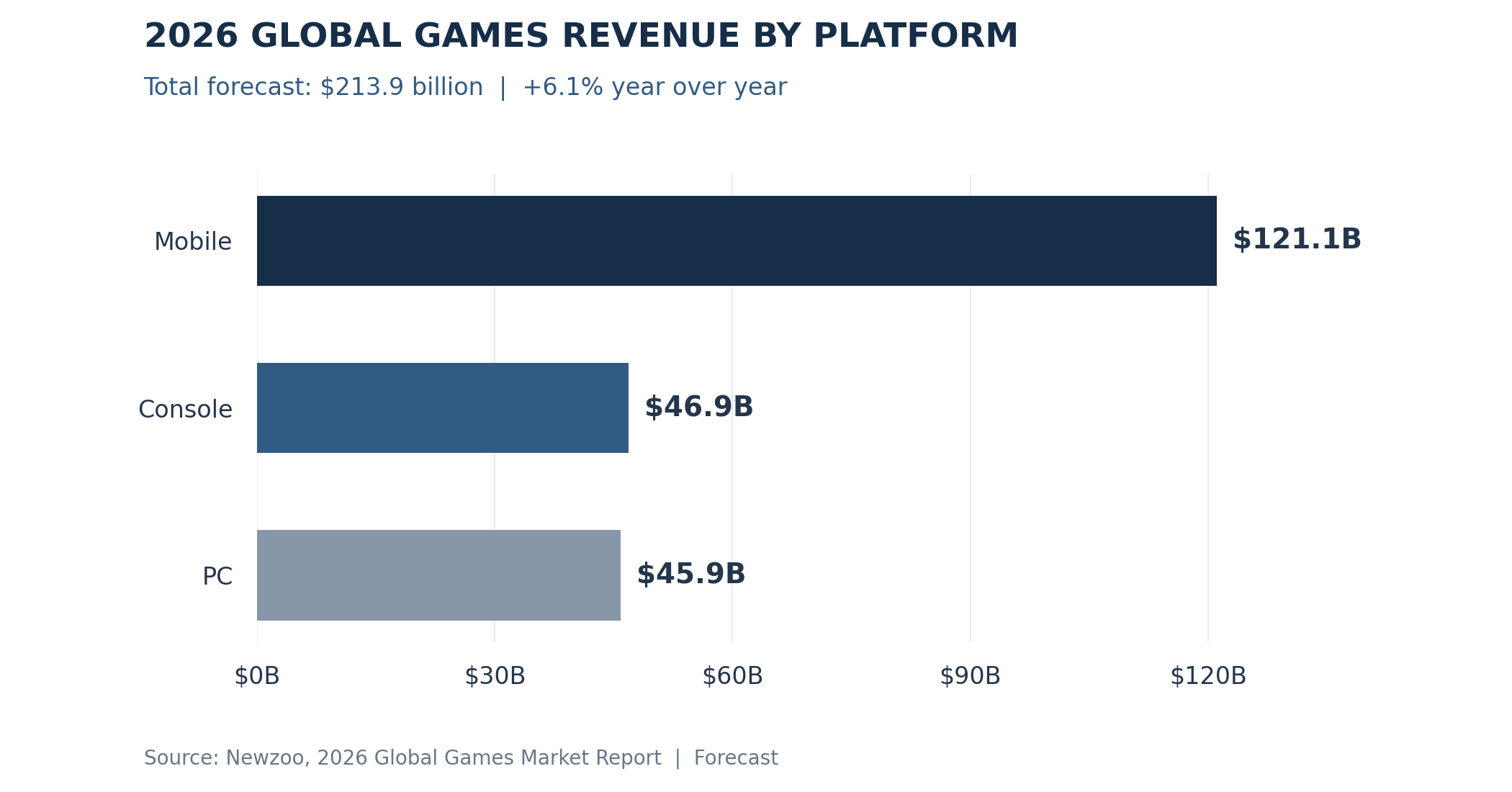
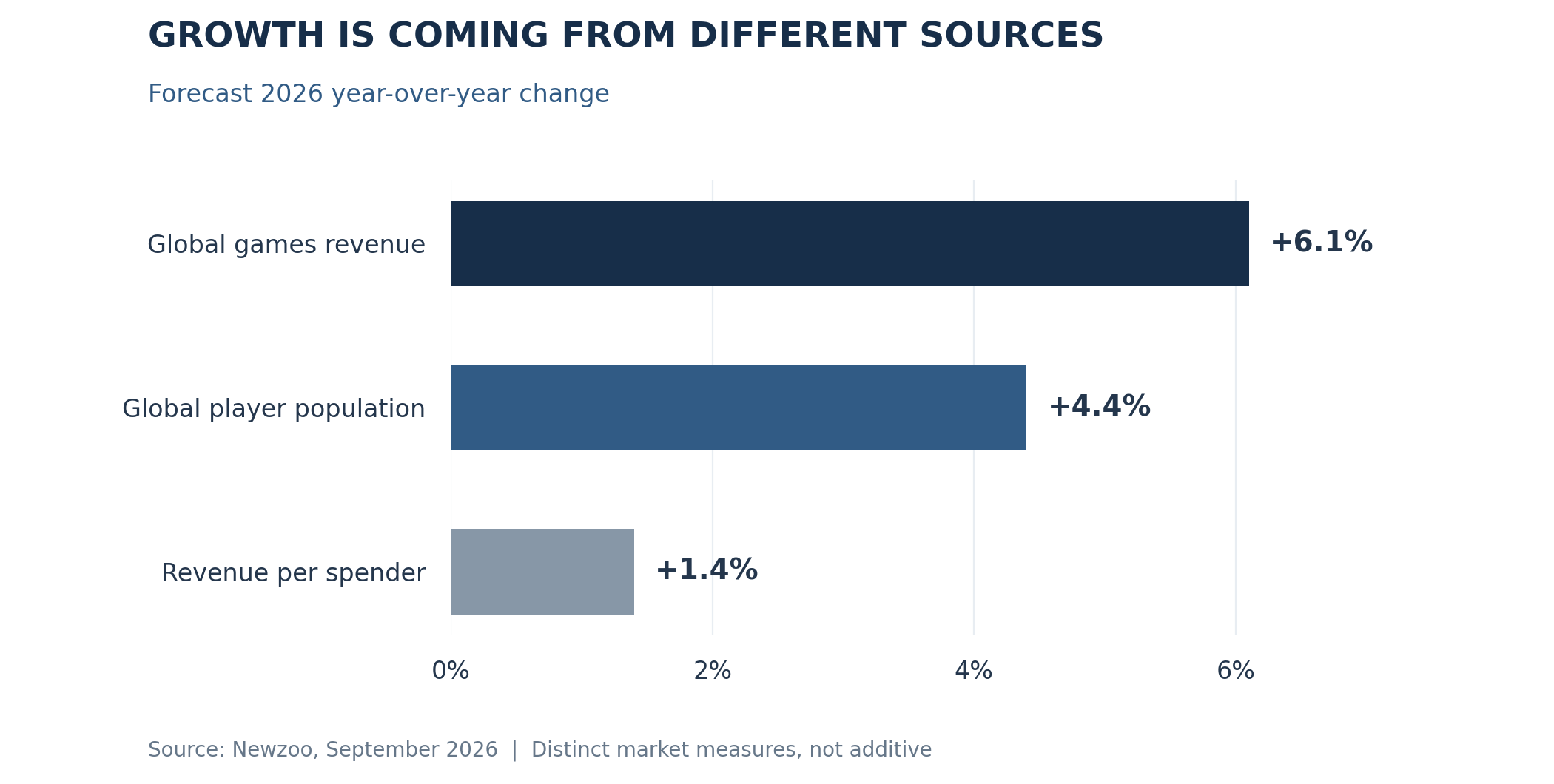
The global video game industry is expected to generate nearly $214 billion in revenue in 2026, an increase of 6.1% over last year, according to Newzoo’s latest Global Games Market Report. With 3.7 billion players worldwide and continued growth across mobile, console, and PC, gaming remains one of the most successful sectors in entertainment. Yet beneath these impressive numbers, the economics of the industry are changing in ways that will have significant implications for how game companies compete.
Newzoo forecasts that player growth will moderate in the coming years, with penetration among the global online population beginning to level off. The number of players is still expanding, but much of that growth is increasingly coming from emerging markets, while established markets compete for the attention and spending of audiences already deeply engaged with games.
For decades, publishers have pursued growth through new games, new players, new platforms, and geographic expansion. Those opportunities remain important, but they are becoming more challenging and expensive to capture. Increasingly, companies will need to create more value from the audiences they already serve.
I believe this represents an important strategic transition for our industry, one that will require publishers to think more expansively about the businesses they build around their games.
The Changing Economics of Growth
The games industry has repeatedly reinvented its business model, evolving from packaged products and physical retail to digital distribution, free-to-play, and ongoing live services. Each transition expanded the commercial opportunity while changing the capabilities required to compete.
One consequence has been the extraordinary longevity of successful games. Minecraft, Roblox, Fortnite, and Grand Theft Auto V have demonstrated how compelling experiences can sustain audiences and commercial relevance for years, sometimes decades. Their success also creates a challenge for new entrants, who must compete against established ecosystems with accumulated content, invested communities, and years of player relationships.
The economics are becoming more demanding. Newzoo expects mobile revenue to grow 6.8% this year despite declining downloads, reflecting the increasing importance of monetizing existing audiences. Across the industry, publishers face growing competition for player attention, rising acquisition costs, and pressure to generate sustainable returns from ongoing operations.
As a result, growth will increasingly depend on how effectively companies retain, engage, and serve their audiences over time.
The Business Beyond the Game
A successful game can create an audience, but the business surrounding that game determines how effectively the company develops the relationship over time. Player engagement, commerce, data, community, and ongoing content all contribute to the economic value of that relationship, often extending well beyond the original transaction.
The expansion of commerce channels offers a good example. Recent research from Omdia highlights how direct-to-consumer commerce platforms are evolving beyond payment processing to include storefront management, analytics, regional payment capabilities, and player engagement tools. These developments give publishers greater flexibility in how they reach, serve, and transact with their audiences.
The opportunity extends beyond reducing platform fees. Better commerce capabilities can improve conversion, support regional pricing strategies, and create more relevant customer experiences. However, additional channels don’t necessarily generate incremental demand, and publishers must evaluate whether those investments improve the overall economics of the business.
These developments connect closely to a framework I’ve developed over many years working across games and entertainment. In my book, Durable Advantage, I describe five interconnected pillars of long-term business success: Relationships, Commerce, Intelligence, Trust, and Time.
Their combined value is particularly relevant to gaming. Strong player relationships create opportunities for ongoing engagement and commerce. Intelligence allows companies to understand those relationships and make better decisions. Trust sustains player loyalty, while time allows the benefits of these capabilities to accumulate and reinforce one another.
The challenge is developing these capabilities as an integrated business rather than allowing them to operate independently.
The Organizational Challenge
This is where I believe many game companies will face their greatest difficulty, and where the next meaningful competitive advantages may emerge.
Our industry has become remarkably sophisticated in developing specialized capabilities. Leading publishers have experienced development teams, performance marketing operations, monetization specialists, analytics functions, LiveOps organizations, and commercial partnerships. Yet these capabilities have often developed within separate departments, each with its own priorities, performance metrics, and accountability.
Consider a publisher seeking to increase the lifetime value of its players. Achieving that objective may require improvements across gameplay, retention, content scheduling, commerce, pricing, marketing, and customer engagement. Each function contributes to the result, but no single team can deliver it independently.
A product team might prioritize engagement while marketing focuses on acquisition volume. Commerce may optimize transactions and payment margins, while finance concentrates on near-term profitability. Each department can achieve its individual objectives without necessarily maximizing the performance of the overall business.
Throughout my career, I’ve seen how much easier it is for companies to invest in new capabilities than to change how their organizations actually operate. Technology can improve individual functions, but the larger opportunity comes from coordinating those functions around shared strategic and commercial outcomes.
Artificial intelligence will make this challenge even more important. AI can accelerate development, improve analysis, and automate operational tasks, but it cannot independently resolve conflicting priorities or fragmented decision-making. Without organizational alignment, companies risk becoming more efficient at pursuing objectives that were never properly coordinated in the first place.
Executives will need to rethink how teams collaborate, how accountability is established, and how success is measured. Traditional metrics such as downloads, active users, and gross revenue remain important, but they must be evaluated alongside retention, customer satisfaction, contribution margins, and long-term player value.
For many publishers, developing these organizational capabilities may prove more difficult than implementing the underlying technologies. It may also become a defining competitive advantage.
Building Durable Advantage
Creative innovation has always been the foundation of the games industry, and great games will continue to create new audiences, establish franchises, and redefine categories of entertainment. But as the market matures, converting that creative success into sustained economic value will require increasingly sophisticated commercial and operational capabilities.
The companies best positioned for this environment will be those that build enduring player relationships, develop flexible commerce infrastructure, turn intelligence into better decisions, and consistently earn their audiences’ trust. Just as importantly, they must organize themselves so these capabilities reinforce one another over time.
The industry’s next phase of growth offers enormous opportunity, but capturing it will demand more than excellence in game development. Publishers will need to become equally skilled at building and operating the businesses that support their games.
The next era of games will be won by companies that can do both.
Sources
Newzoo, Global Games Market Report 2026, September 15, 2026
Newzoo, 2026 Global Games Market Key Numbers, August 25, 2026
Omdia, Mobile Game Developers Accelerate D2C Adoption, September 23, 2026
